

ideas
Outdoor Wall Cladding Australia: A Complete Guide to Stone Exterior Panels
Australian homes are built around outdoor living. The alfresco wall, the outdoor kitchen surround, the garden boundary wall, the pool pavilion facade. These surfaces take real punishment from the Australian climate and they are on display every time you step outside. Choosing the right outdoor wall cladding material matters enormously, both for how it performs over time and for how it looks. Stone is one of the best outdoor wall cladding materials available in Australia. It handles heat, UV, rain, and salt air better than most alternatives. This guide covers everything you need to know about choosing, specifying, and installing stone outdoor wall cladding for an Australian property. Why Stone Is One of the Best Outdoor Cladding Materials in Australia Australia's climate is tough on building materials. UV radiation at Australian latitudes degrades many products faster than comparable climates in Europe or North America. Temperature swings between winter and summer, particularly in inland areas, cause expansion and contraction that can stress finishes over time. Coastal properties deal with salt air corrosion that attacks metals, timbers, and synthetic materials. Natural stone handles all of these conditions well. It does not fade under UV exposure the way painted surfaces or composite materials can. It has very low thermal expansion relative to its mass. And it is chemically inert, meaning salt air has little effect on it. Properly installed stone outdoor wall cladding on an Australian home should last the life of the building with minimal maintenance. Best Stone Types for Outdoor Wall Cladding in Australia Slate Slate is the most popular choice for exterior stone wall cladding in Australia and for good reason. It is a dense, low porosity metamorphic rock that handles moisture exposure extremely well. Its natural cleavage planes create a textured, layered surface that conceals weathering and ageing well over time. Available in charcoal, rust, grey green, and multicolour varieties, slate suits both contemporary and traditional Australian architecture. Sandstone Sandstone is a quintessentially Australian material with deep roots in the country's building history. Its warm honey and buff tones complement the Australian landscape in a way that no imported material can replicate. For exterior applications, sandstone requires sealing to prevent moisture absorption and staining. Properly sealed, it is a highly durable outdoor cladding material that improves in character as it ages. Quartzite Quartzite is harder and denser than most stone types, with excellent resistance to weathering and abrasion. It is particularly well suited to high traffic exterior surfaces such as wall bases in outdoor living areas where chairs and furniture may make contact with the wall. Australian Climate Considerations UV and heat All natural stone handles UV exposure without fading. However, darker stone colours absorb more heat in direct summer sun. In very hot climates such as Darwin, Brisbane, or inland Western Australia, lighter stone tones are more comfortable in outdoor spaces where people sit close to the walls. Coastal environments Salt air has minimal effect on natural stone itself but can degrade some adhesive and sealant systems over time. For coastal properties, specify adhesive and grout products with explicit salt air or marine environment ratings. Sketch can advise on the right system for your location. Fire risk areas For properties in bushfire prone zones, the construction requirements are governed by AS 3959. Natural stone cladding is non combustible and performs well in BAL rated construction. The specific BAL rating that stone cladding can satisfy depends on the installation system and substrate. Always confirm compliance with your certifier before committing to a specification. Important for BAL rated areas: Non-combustible stone cladding panels can contribute to BAL compliance but the entire wall system including substrate, adhesive, and cavity must be assessed together. Ask Sketch for the relevant technical documentation for your build. Outdoor Wall Cladding Installation Considerations Exterior installations require more attention to the installation system than interior work because of exposure to moisture, thermal movement, and wind loading. Use an exterior rated flexible adhesive, not standard tile adhesive Grout all joints fully to prevent water ingress behind panels Apply a penetrating stone sealer to sandstone and lower porosity stones before first exposure to rain Allow for thermal movement joints every 3 to 4 metres in large exterior installations Ensure adequate drainage at the base of cladded walls so water does not pool against the stone Popular Outdoor Applications for Stone Wall Cladding Alfresco and outdoor entertaining areas The outdoor living wall behind a built in BBQ or outdoor kitchen is the most popular residential application for stone wall cladding in Australia. Stone handles heat from outdoor cooking and weathering from rain without any of the maintenance that timber or painted surfaces require. Pool walls and surrounds Stone cladding around pool walls and equipment enclosures creates a resort style aesthetic that ages beautifully. Use slate or quartzite in pool environments for their low porosity and resistance to pool chemicals. Garden and boundary walls A cladded garden wall in sandstone or slate instantly elevates the quality of an outdoor space. These walls take no direct structural load from the cladding and are straightforward to install with standard thin stone veneer panels. Building facades and feature panels Stone cladding on the exterior of a home is a significant design statement that adds real value to the property. Even a partial facade application, such as a stone panel feature at the entry or around the garage, makes a powerful architectural impression. Maintenance Requirements for Outdoor Stone Cladding Natural stone outdoor wall cladding requires very little ongoing maintenance compared to painted or coated surfaces. The main tasks are resealing every two to three years, particularly for sandstone, and cleaning with water and a stone safe cleaner to remove dirt and moss in shaded areas. Avoid pressure washing at high pressure directly onto the stone surface as this can erode grout joints over time. A medium pressure wash at appropriate distance is fine for general cleaning.
Learn allThin Stone Veneer vs Traditional Stone Cladding: Which Is Right for Your Australian Home?
If you want the look of natural stone on your walls, you have two very different ways to get there. Traditional stone cladding has been used in Australian construction for generations. Thin stone veneer is a newer category of product that has changed the equation significantly. Understanding the differences between them helps you choose the right option for your project, your budget, and your wall. What Is Traditional Stone Cladding? Traditional stone cladding refers to pieces of natural stone that are cut or split to a thickness of 20mm or more and applied to an existing wall structure. The stone is genuinely thick and heavy. Installation requires a solid masonry or rendered substrate, mechanical fixing in many commercial applications, and a skilled stonemason for larger projects. The weight per square metre is typically between 40 and 80 kilograms depending on the stone species and cut thickness. Traditional cladding has been used on Australian homes for decades, particularly in period homes, heritage restorations, and high end custom builds where the depth and shadow of thick stone is part of the design brief. What Is Thin Stone Veneer? Thin stone veneer panels are made by slicing natural stone to a thickness of 1 to 3 millimetres. This process uses precision cutting equipment rather than any synthetic or manufacturing process. The result is 100 percent genuine natural stone, with all the same colour variation, texture, and character as traditional stone, but at a fraction of the weight. The thin stone slice is bonded to a fibreglass mesh or flexible polymer backing that holds it together and makes it safe to handle, cut, and install. Sketch supplies thin stone veneer panels in slate, marble, sandstone, quartzite, and several specialty finishes including translucent stone. Weight Comparison Weight is the most significant practical difference between the two product types and it has enormous implications for what you can do with each. Traditional stone cladding at 20mm thickness weighs 40 to 80 kilograms per square metre. Standard residential wall structures are rarely designed to handle this load without engineering assessment, which adds cost and time to any project. Thin stone veneer panels typically weigh 3 to 8 kilograms per square metre. This is light enough to go directly onto standard plasterboard walls with no structural assessment required. It is also light enough for ceiling applications, furniture installation, and curved surfaces that would be impossible with traditional cladding. Installation Comparison Traditional stone cladding Requires a masonry or rendered substrate. Mechanical fixings are often needed for exterior or large scale applications. Professional installation is typically essential for anything beyond a small garden wall. Installation is slow, labour intensive, and costly. Thin stone veneer Installs directly onto plasterboard, concrete, masonry, or timber frame with flexible tile adhesive. No mechanical fixings required for most residential applications. Suitable for experienced DIY installation. Much faster than traditional cladding. Rule of thumb: A two person professional crew can install approximately 25 to 30 square metres of thin stone veneer per day. The same crew would manage 8 to 12 square metres of traditional stone cladding in the same time. Cost Comparison Material costs for thin stone veneer and traditional stone cladding can be similar per square metre for equivalent stone species. The significant cost difference comes from installation. Traditional stone cladding requires specialist labour and often structural engineering assessment. Thin stone veneer can be installed by a tiler or an experienced DIYer. For a typical 10 square metre feature wall in an Australian home, the total installed cost difference between the two approaches can be $2,000 to $5,000 in favour of thin stone veneer when you account for labour and substrate preparation. Aesthetics: Does Thin Stone Veneer Look as Good? This is the question most people ask and the honest answer is that the visual result is virtually identical in most applications. Because thin stone veneer is genuine natural stone with the same face texture, colour, and character as traditional cladding, the finished appearance is extremely similar. The depth of shadow in the joints can vary slightly depending on joint width, but a well installed thin stone veneer wall is indistinguishable from traditional cladding to most observers. The one area where traditional stone cladding has a genuine aesthetic advantage is in applications where the stone reveals significant thickness at an edge, such as a freestanding garden wall or a window sill where the stone section is visible. In these cases the depth of traditional stone is part of the design. For wall applications where only the face is visible, thin stone veneer delivers the same result. Durability and Longevity Both product types use genuine natural stone, which is one of the most durable materials available. The durability of either product in a wall application depends primarily on the installation quality and the choice of adhesive and grout system rather than the stone itself. Properly installed thin stone veneer panels with quality adhesive, grout, and sealer will last as long as a traditional stone cladding installation. Which Should You Choose? Choose traditional stone cladding if you need genuine stone depth visible at edges, if you are working on a heritage restoration where the original stone thickness matters, or if you are building a freestanding wall where the stone is structural or semi structural. Choose thin stone veneer if you are applying stone to a standard residential wall, if budget or timeline matters, if you want to DIY the project, or if your wall structure cannot take the weight of traditional cladding. For the vast majority of Australian residential and commercial interior applications, thin stone veneer is the smarter choice.
Learn allHow to Install Stone Veneer Wall Panels: A Step by Step Guide for Australian Homes
Stone veneer wall panels are one of the most rewarding DIY projects an Australian homeowner can take on. The result looks like a professional stone installation but the process is far more approachable than traditional masonry. Whether you are covering an internal feature wall, a fireplace surround, or an exterior alfresco wall, this guide walks you through every stage from preparation to the finished product. At Sketch we supply thin stone veneer panels to homeowners and trade professionals across Australia. The installation advice below is based on real experience with our products on Australian substrates and in Australian conditions. What You Need Before You Start Good preparation is the difference between a stone wall that looks perfect for twenty years and one that develops problems within twelve months. Before you touch a single panel, gather the following: Thin stone veneer panels from Sketch (order 10% extra for cuts and waste) Flexible tile adhesive rated for stone and the substrate you are working on Waterproof membrane if working in a wet area or bathroom Notched trowel (6mm or 8mm depending on panel thickness) Rubber mallet Angle grinder or diamond blade tile saw for cutting Spirit level Grout or pointing compound in a colour that suits your stone Stone sealer for finishing Safety glasses and dust mask for cutting Step 1: Prepare the Wall Surface The wall must be clean, flat, dry, and structurally sound before any stone veneer panels go up. Remove any paint that is peeling or flaking. Fill any cracks or dips in the surface with a suitable filler and allow it to cure fully. For plasterboard walls, ensure all screws are flush and the board is firmly fixed to the studs. Plasterboard is a perfectly suitable substrate for thin stone veneer panels because of their low weight compared to traditional stone cladding. For wet areas such as bathroom feature walls, apply a waterproof tanking membrane to the entire surface and allow it to cure before applying adhesive. This is not optional in any zone within 1.5 metres of a water source. Key point: Skipping surface preparation is the most common reason stone veneer installations fail. Spend the time here and every step after becomes easier. Step 2: Plan Your Layout Lay your panels out on the floor in front of the wall before applying any adhesive. This lets you plan your layout, check for colour variation across the batch, and work out where your cuts will fall. Start from the bottom and work up, keeping full panels at eye level wherever possible. The most visible part of the wall should have the least cuts. Mark a level horizontal line across the wall at your starting course height using a pencil and spirit level. Step 3: Mix and Apply the Adhesive Mix your flexible stone tile adhesive according to the manufacturer instructions. The adhesive should have a smooth, peanut butter consistency and should hold its shape when you press it without slumping. Apply adhesive to the wall using the flat side of your notched trowel, then comb it with the notched side to create uniform ridges. Work in sections of about half a square metre at a time so the adhesive does not skin over before you place the panels. Back butter each stone veneer panel with a thin skim of adhesive as well. This improves bond coverage, which is especially important on textured panel surfaces. Step 4: Place and Set Each Panel Press each panel firmly into the adhesive with a slight twisting motion to collapse the ridges and ensure full contact. Use a rubber mallet to tap the panel flat, checking with your spirit level as you go. Leave consistent joint gaps between panels using spacers if needed. Work from the bottom course upward, staggering the vertical joints between rows like brickwork. This creates a stronger visual result and a more stable installation. Step 5: Cut Panels for Edges and Corners Stone veneer panels cut cleanly with a diamond blade angle grinder or a wet tile saw. Always cut on the face side and wear safety glasses and a dust mask. For outside corners, mitre both panels at 45 degrees for a neat finish. For inside corners, one panel simply overlaps the other. Step 6: Allow Full Cure Before Grouting Allow the adhesive to cure fully before applying grout or pointing compound. This is typically 24 hours for interior applications and up to 48 hours for exterior or wet area projects. Check the adhesive manufacturer instructions for the specific product you are using. Step 7: Grout or Point the Joints Apply grout or pointing compound to fill the joints between panels. For natural stone, a matching or complementary tone usually looks best. Remove excess grout from the face of the stone with a damp sponge before it sets hard. Pro tip: For a natural stone look, slightly recess the grout joints so they sit just below the surface of the panels rather than flush with them. Step 8: Seal the Stone Apply a penetrating stone sealer to the entire installation once the grout has cured. This protects the stone from staining, reduces moisture absorption, and makes ongoing cleaning much easier. Reapply sealer every two to three years for exterior installations or whenever water stops beading on the surface. Common Installation Questions Can I install stone veneer panels myself? Yes. Sketch thin stone veneer panels are lightweight and designed to be installed by homeowners with basic DIY skills. The most important step is preparation. If the surface is right, the installation is straightforward. How long does installation take? An experienced installer can complete 10 to 15 square metres per day. For a first time installer, expect to cover 5 to 8 square metres per day for a feature wall project. Do I need a professional for wet areas? The tiling work itself is DIY friendly but we strongly recommend consulting a licensed builder or waterproofer for the membrane application in wet zones to ensure compliance with Australian building standards.
Learn allCarbon Crystal Wall Panels: The Future of Interior Design in Australia
Every decade or so, a genuinely new material emerges in interior design — something that doesn't look like anything that came before it, that creates possibilities that simply weren't possible with earlier products. Carbon Crystal Boards (CCB) are that material for the 2020s. If you haven't encountered them yet, you're about to understand why designers and architects across Australia are talking about them. What Are Carbon Crystal Boards? Carbon Crystal Boards are an advanced composite panel material with a distinctive translucent or semi-translucent quality. When light passes through them — natural or artificial — they have an appearance often compared to gemstones, crystalline ice, or backlit resin art. Unlike stone, timber, or ceramic, CCB doesn't have a direct natural reference point. It looks like nothing else. The panels are manufactured through a process that creates a highly consistent internal crystalline structure. This structure is what gives CCB its extraordinary light-refracting qualities and its depth of colour. Available in a wide range of tones from deep blacks and charcoals through to soft milky whites, translucent ambers, and vibrant jewel tones, there's a Carbon Crystal Board to suit almost any design direction. What Makes Carbon Crystal Boards Different? Most wall panel materials are opaque — they sit on the wall and reflect light from their surface. CCB panels interact with light differently. Backlit CCB glows from within, creating a luminous quality that shifts as the ambient light in the room changes. During the day, a CCB panel reads one way. In the evening with backlighting activated, it becomes something entirely different. This dynamic relationship with light makes CCB ideal for applications where the wall is meant to be experienced, not just seen — bars, feature walls, room dividers, reception areas, and anywhere that needs to make a lasting impression. Designer's note: CCB looks completely different in daylight vs artificial light. When planning a CCB installation, always consider both lighting conditions. Backlighting is optional but dramatically changes the impact. Where Are Carbon Crystal Boards Used? Residential Feature Walls The most popular residential use is as a statement feature wall — in a living room behind the TV unit, in a home theatre, or as a dramatic headboard wall in a master bedroom. The reflective, luminous quality of CCB adds depth to any space and works particularly well in rooms with controlled or moody lighting. Bar and Hospitality Fit-outs CCB has become a favourite material in hospitality design because it photographs beautifully and creates an immediate atmosphere. A backlit CCB panel behind a bar or spirit display creates the kind of visual impact that brings customers back. Several high-profile Australian bar and restaurant fit-outs have used CCB as their signature material. Commercial Reception and Lobby Walls First impressions matter enormously in commercial spaces, and a Carbon Crystal Board feature wall in a reception area or building lobby delivers the kind of impact that stone or timber simply can't. CCB is increasingly specified by architects and interior designers for corporate, medical, and retail fit-outs. Room Dividers Semi-translucent CCB panels used as room dividers allow light to move between spaces while maintaining visual separation. This application works beautifully in open-plan homes and offices where hard walls feel too closed and glass feels too exposed. Furniture and Joinery Beyond walls, CCB is being used in custom joinery — cabinet fronts, shelving inserts, table tops, and built-in furniture. The material machines cleanly and can be cut and shaped to suit almost any application. Visit our gallery to vitness the magic. How Do Carbon Crystal Boards Install? CCB panels are typically installed using a proprietary adhesive system or mechanical fixing, depending on the application. For wall applications, the process is similar to installing large-format tiles — the substrate needs to be flat, clean, and dry, and the panels are bonded using a compatible adhesive. Joints can be left open for a panel look or filled with a colour-matched sealant. For backlit applications, the panels are typically installed on a frame with LED strip lighting behind them. The specific lighting setup depends on the translucency of the panel chosen and the intensity of glow desired. Are Carbon Crystal Boards Durable? CCB is a hardwearing, impact-resistant material suitable for both commercial and residential use. It's resistant to moisture and can be cleaned with standard non-abrasive cleaners. For high-traffic commercial applications, it's worth discussing the specific panel specification with our team to ensure the product matches the demands of the space. Where Can You Buy Carbon Crystal Boards in Australia? Sketch is one of the very few Australian suppliers of Carbon Crystal Boards. We stock a range of CCB panels in different colour families, translucencies, and finishes, available for homeowners, designers, and builders across Australia. Our team can provide samples, technical data sheets, and installation guidance. If you're working on a project that calls for something genuinely new and different, Carbon Crystal Boards deserve a serious look. Browse our CCB range or contact the Sketch team to discuss your project.
Learn allSandstone vs Slate Wall Panels: Which Is Right for Your Australian Home?
Two of the most popular stone wall panel choices for Australian homes are sandstone and slate. Both are natural stones. Both are available as thin veneer panels that can be applied to standard interior and exterior walls. But they look completely different, behave differently, and suit different spaces. If you're trying to choose between them, this guide will help you make the right call. The Look: What's the Visual Difference? Sandstone Sandstone has a warm, earthy quality that feels distinctly Australian. Its tones tend to run through buffs, honeys, cream, and terracotta — the colours of the Australian outback and the historic sandstone buildings of Sydney and Brisbane. The texture is typically smooth to gently granular, with a matte finish that absorbs light rather than reflecting it. In a home, sandstone wall panels create warmth and a sense of organic, natural comfort. They pair naturally with timber, rattan, linen, and other natural materials. They're the choice for spaces that feel grounded, relaxed, and connected to the landscape. Slate Slate is cooler, more dramatic, and more directional. Its natural cleavage planes create a layered, stratified texture that has strong visual depth. Slate tones run from deep charcoal and dark grey through to rust-red, green-grey, and multicolour varieties. The surface has a matte sheen and the layers catch light at different angles, creating a constantly shifting appearance as the light changes through the day. Slate wall panels suit contemporary, industrial, and moody interiors. They pair well with dark metals, polished concrete, and minimalist furnishings. They make a strong statement without trying too hard. Durability: How Do They Compare? Both sandstone and slate are natural stones that have been used in construction for centuries — so durability isn't really a question of one being weak. But they do have different characteristics worth understanding. Sandstone Sandstone is a sedimentary rock and is slightly more porous than slate. This means it benefits from sealing, particularly in exterior applications or areas that will be exposed to moisture. Unsealed sandstone can absorb water and, in high-exposure environments, may show staining over time. Properly sealed, it's a highly durable material that performs well outdoors in the Australian climate. Slate Slate is a metamorphic rock — it's been subjected to heat and pressure over millennia, making it denser and less porous than sandstone. It has natural water-resistant properties and is widely used in wet areas and exterior applications without sealing (though sealing is still recommended for best long-term performance). Slate is also slightly harder and more resistant to chipping and scratching than sandstone. Winner for wet areas: Slate has a natural advantage in bathrooms and exterior walls exposed to heavy rain. Sandstone is perfectly suitable with sealing, but slate requires less maintenance. Cost: Is One More Expensive? In the Australian market, sandstone and slate wall panels are generally in a similar price bracket when comparing equivalent panel types. Thin stone veneer panels in both materials typically range from $80–$150 per square metre, depending on the specific product and finish. Premium or specialty cuts of either stone can cost more. Sketch stocks a range of both sandstone and slate panels at various price points. We recommend requesting samples and comparing like-for-like before making a purchasing decision based on price alone. Best Uses: Where Does Each Shine? Choose Sandstone If You Want: Warmth and organic earthiness in your space A natural material that feels distinctly Australian A relaxed, resort-style outdoor entertaining area A feature wall in a living room or bedroom with warm-toned furniture A material that pairs well with timber and natural fibres Choose Slate If You Want: A dramatic, high-contrast feature wall A material that suits a contemporary or industrial interior A naturally water-resistant stone for bathrooms or exterior walls Depth and texture in a darker, moodier colour palette Flexibility for both interior and exterior applications with minimal maintenance Can You Use Both? Absolutely. Some of the most interesting interiors use two different stone types in the same space — sandstone on an exterior alfresco wall paired with slate in the adjacent indoor kitchen, for example. The contrast between the warm tones of sandstone and the cool drama of slate can be genuinely beautiful when handled thoughtfully. The key is to establish a clear logic to the choices — stone type follows the function of the space, or it follows the colour palette, not both at once. Order Samples and See for Yourself The best way to choose between sandstone and slate is to order samples of both and hold them up in your space. Natural stone changes dramatically in different lighting conditions — what looks cool and grey in the showroom can look quite different under warm downlights in your living room. Sketch makes sampling easy. Browse our range and order your samples online today.
Learn allWall Panelling for Bathrooms: Ideas and Everything You Need to Know
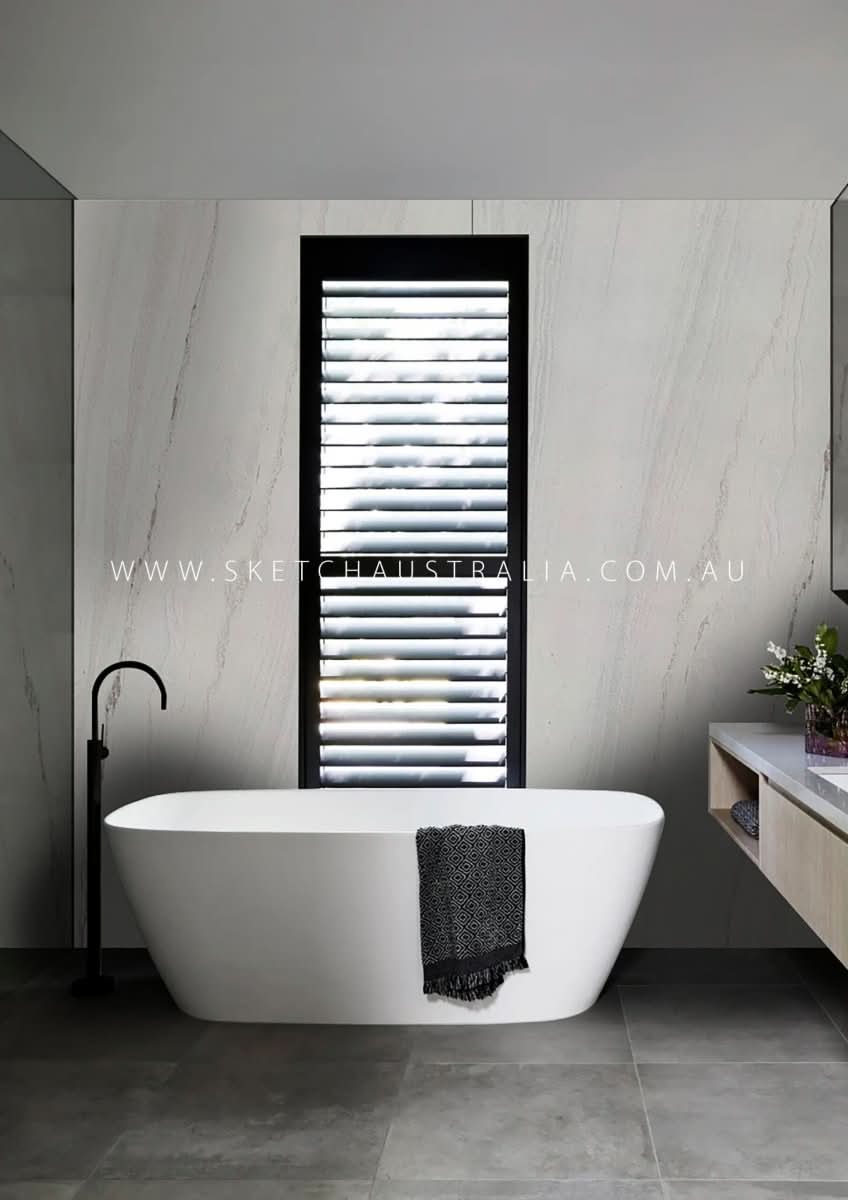
The bathroom might be the most underestimated room in the house when it comes to design. For most of us, it's the first room we enter every morning and the last one we leave at night — yet it often gets the least creative attention. Wall panelling is changing that. From natural stone feature walls to full marble surrounds, the right wall panelling can completely transform your bathroom from functional to genuinely beautiful. This guide covers the best wall panelling options for Australian bathrooms, what to watch out for in wet areas, and how to get the look you're after. Can You Use Wall Panels in a Bathroom? Yes — but the key is choosing the right product and installing it correctly. Bathrooms are wet areas, which means any wall panelling needs to be either naturally water-resistant or properly sealed and waterproofed before installation. The good news is that most natural stone panels — slate, marble, and sandstone — are entirely suitable for bathroom walls when installed with the right adhesive and grout system. Important: Always apply a waterproof membrane behind any wall panelling in wet zones (shower walls, areas within 1.5m of a bath). This is Australian building standard practice, not optional. Best Wall Panel Materials for Bathrooms Marble Wall Panels Marble is the classic choice for bathroom wall panelling — and for good reason. Its natural veining, cool smooth surface, and association with luxury make it the go-to material for high-end bathroom renovations. Sketch's marble wall panels come in thin stone veneer format, meaning they're lightweight enough to go directly onto plasterboard (with waterproof membrane) and don't require structural reinforcement. Popular applications: full-height shower walls, the wall behind a freestanding bath, vanity feature wall. Slate Wall Panels Slate brings a completely different energy to a bathroom — raw, textural, and grounded. It's particularly popular in contemporary and industrial-style bathrooms where the contrast between rough stone and polished chrome fixtures creates an interesting tension. Slate is naturally water-resistant and one of the most durable stone types for wet area use. Translucent Stone Panels For something genuinely unique, translucent stone panels backlit in a shower or behind a vanity create a spa-like glow that's hard to replicate with any other material. Sketch carries six translucent stone panel options, each with distinctive natural patterning. These are increasingly popular in high-end residential and boutique hotel fit-outs. Feature Wall Ideas for Bathrooms The Freestanding Bath Wall If you have a freestanding bath, the wall behind it is prime real estate for a statement material. A full run of marble wall panels — floor to ceiling, the width of the bath — creates the kind of bathroom you see in design magazines. Keep everything else simple: white plumbing, natural timber, minimal accessories. The Shower Feature Wall Rather than tiling every surface in the shower the same way, consider using stone wall panels on the main face wall only, with a complementary plain tile on the other three walls. This approach is more cost-effective than covering everything in stone and creates a clear focal point. The Vanity Splashback Even a small run of stone or marble panelling behind your vanity and mirror adds a level of finish that painted walls simply can't achieve. This is a low-cost, high-impact upgrade that can often be completed in a few hours. Half-Wall Panelling A classic approach in both traditional and contemporary bathrooms is to panel the lower half of the wall — typically to 1.2 or 1.5 metres — with stone panels, and paint or tile above it. This creates a clear visual break, is easier on the budget than floor-to-ceiling stone, and protects the most vulnerable section of wall from water splashing. Installation Tips for Bathroom Wall Panelling Always apply a waterproof tanking membrane in wet zones before panel installation Use a flexible tile adhesive rated for wet areas — standard adhesives can fail in humid environments Seal all grout joints with a penetrating stone sealer to prevent staining and mould For marble and light-coloured stone, use a light-coloured grout to avoid dark lines dominating the look Ensure adequate ventilation in the bathroom — good airflow extends the life of any wall finish How Much Does Bathroom Wall Panelling Cost? The material cost varies depending on the stone type. As a rough guide for Australian bathrooms: Slate wall panels: from $80–$130 per square metre Marble wall panels: from $120–$280 per square metre Translucent stone panels: from $200 per square metre A typical ensuite feature wall of 3–4 square metres would cost $300–$1,200 in materials depending on your stone choice. Full bathroom renovations using stone panelling across multiple walls are obviously larger investments, but the longevity and impact of natural stone make it a strong one. Browse Sketch's Bathroom Wall Panel Range Sketch stocks over 30 marble, slate, and specialty stone panels suitable for bathrooms and wet areas. We can help you choose the right product for your space, calculate quantities, and advise on the correct installation system. Order samples online or contact our team for personalised advice.
Learn allStone Cladding Panels Australia: A Complete Guide for Homeowners
Stone cladding has been used in Australian architecture for generations — from the bluestone facades of Melbourne's heritage buildings to the sandstone cottages of regional New South Wales. But the way we use stone in modern homes has changed dramatically. Today, stone cladding panels make it possible to bring the beauty and character of natural stone to almost any wall, inside or out, without the cost, weight, or complexity of traditional masonry. This guide covers everything you need to know about stone cladding panels in Australia — what they are, how they're installed, what they cost, and how to choose the right product for your project. What Are Stone Cladding Panels? Stone cladding panels are thin sections of natural stone — typically 3 to 20mm thick — that are applied to the surface of an existing wall. Unlike full stone construction, where the stone is load-bearing, cladding is purely decorative and protective. The structural work is done by the wall behind it; the stone cladding provides the aesthetic finish. Modern stone cladding panels come in several forms: Thin stone veneer panels (1–3mm): ultra-lightweight, flexible, suitable for plasterboard Split-face or ledgestone panels (10–20mm): thicker, more textured, used for exterior applications Stacked stone tiles: pre-assembled sections of irregular stone pieces Peel and stick stone panels: self-adhesive backing for fast installation What Types of Stone Are Available in Australia? Slate One of the most popular choices for both interior and exterior cladding in Australia. Slate has a naturally layered, split-face texture that creates strong visual depth. Available in charcoal, rust, grey-green, and multicolour varieties. Highly durable and suitable for wet areas. Sandstone A quintessentially Australian stone, sandstone has warm buff, honey, and terracotta tones that sit beautifully in the Australian landscape. Particularly popular for exterior cladding, garden walls, and alfresco areas. Sketch sources sandstone panels in a range of finishes from rough-hewn to smooth-faced. Marble For interior applications where luxury is the priority, marble cladding panels are unmatched. White, grey, black, and green marble varieties all have their own distinctive character. Marble is best suited to interior walls, feature panels, and bathroom applications. Quartzite A harder, more durable alternative to marble with similar elegance. Quartzite panels work well in both interior and exterior applications and are more resistant to weathering than marble. Interior vs. Exterior Stone Cladding One of the most important decisions is whether your stone cladding panels need to perform outdoors or indoors — and not all products are suitable for both. For interior stone cladding, the main considerations are weight (will the wall support it?), moisture resistance (is this a wet area?), and aesthetics. Thin stone veneer panels are ideal for interior feature walls because they're lightweight enough to go on standard plasterboard. For exterior stone cladding, you need to think about UV resistance, freeze-thaw performance (less relevant in most of Australia, but important in alpine areas), and how the stone will handle Australian summer heat. Slate, sandstone, and quartzite all perform well in exterior applications. Always check that the adhesive and grout system you use is rated for outdoor use. Australian climate note: In coastal areas, ensure your stone cladding and fixing system are rated for salt air exposure. Ask the Sketch team for recommendations specific to your location. How Are Stone Cladding Panels Installed? The installation method depends on the panel type and substrate: Thin Stone Veneer Panels Applied with flexible tile adhesive directly onto the prepared wall surface. Can go over plasterboard, render, concrete, or masonry. Grout or pointing compound is used to fill the joints. This is the most DIY-friendly option. Split-Face and Ledgestone Panels Heavier panels typically require a rendered or masonry substrate. Commercial projects may use mechanical fixing systems in addition to adhesive, particularly for large exterior areas. Peel and Stick Panels The fastest installation method — self-adhesive backing means no adhesive mixing, no mess. Best suited to feature walls where the surface is clean, dry, and flat. How Much Do Stone Cladding Panels Cost in Australia? Pricing varies considerably depending on the stone type, thickness, and finish. As a general guide for the Australian market: Entry-level thin stone veneer: from $60–$90 per square metre Mid-range slate and sandstone panels: $90–$150 per square metre Premium marble and quartzite panels: $150–$300+ per square metre Installation costs are additional and will vary depending on the complexity of the job, the substrate, and your location. For straightforward feature walls, experienced tilers typically charge $40–$80 per square metre for labour. Choosing the Right Stone Cladding Panel for Your Project Here's a simple framework to guide your decision: Interior feature wall, plasterboard substrate → thin stone veneer panel Bathroom or wet area → slate or porcelain-backed stone panel, fully waterproofed Exterior cladding, rendered wall → split-face slate or sandstone panel Fast DIY installation → peel and stick stone panel Maximum luxury, interior only → marble or quartzite veneer Get Samples Before You Commit Stone is a natural material and every batch has variation in colour, texture, and tone. The single best thing you can do before ordering a full quantity is to request samples and view them in the actual space where they'll be installed — in natural and artificial light, next to your flooring, cabinetry, and furnishings. Sketch offers sample orders across our full stone cladding range. Contact our team or order directly through our website.
Learn allWaterproof Bathroom Cladding Melbourne: Durable and Stylish Solutions by Sketch Australia
Waterproof Bathroom Cladding Solutions by Sketch Australia When planning a bathroom renovation, the cladding you choose plays a big role in how your bathroom will look and how long it will last. From personal experience, dealing with moisture and damp walls is frustrating, so choosing the right waterproof bathroom cladding can save you many headaches down the road. At Sketch Australia, we focus on providing waterproof bathroom cladding in Melbourne that combines durability with elegant designs to make your bathroom both beautiful and practical. Experience: Why Waterproof Bathroom Panels Matter Bathroom walls get wet daily, whether from shower splashes, steam, or humidity. If your walls aren’t properly protected, you might face issues like mold, mildew, or even wall damage that requires expensive repairs. Waterproof cladding panels act as a solid barrier against moisture, keeping your walls safe and dry. At Sketch Australia, our cladding panels come with smooth, grout-free surfaces that make cleaning easy — a relief for anyone who’s tired of scrubbing grout lines. We’ve had customers share how much easier their bathroom upkeep is after installing waterproof panels compared to traditional tiles. The panels last longer without peeling or cracking and improve the room’s overall look with various styles and finishes—from natural stone aesthetics like travertine and marble sheets for walls to sleek modern designs. Explanation: Stone Veneer vs Brick Cladding If you’re also considering wall cladding beyond the bathroom—such as for the fireplace or exterior walls you might wonder about the best material between stone veneer and brick cladding. Here’s what experience and experts say: Stone Veneer: This is a lightweight, natural-looking option that gives you the charm of real stone without the heavy weight or high cost of full stone walls. It’s great for interior stone wall cladding and external stone cladding, offering versatility and a timeless look. Many prefer stone veneer because it comes in different textures and colors like slate wall panels or sandstone wall interiorthat can add depth and character to any room. Brick Cladding: Brick offers a consistent and classic look which many homeowners love for its simplicity and durability. Brick is heavier and usually requires a more solid wall base, but it can be very effective outdoors or for feature walls indoors. Compared to stone veneer, brick cladding can be less customizable in color but often fits traditional and modern designs well. Choosing between the two depends on your style, budget, and installation needs. For instance, castellated cladding is another unique style that provides ribbed panels adding texture and shadow effects, ideal for modern homes. Tips: Selecting the Perfect Cladding for Your Home Know Your Environment: Bathrooms and kitchens need materials that can handle moisture and heat. Always pick cladding with high waterproof ratings certified for wet areas. Consider Style and Colors: Whether you want the warm, natural look of travertine wall tile or a glossy finish from marble sheets, ensure it matches your room’s color scheme and your personal design taste. Surface Texture Matters: Smooth panels are easier to wipe clean and maintain, while textured or patterned stone panels add a unique style but may require more care. Installation Options: Think about whether you want to do a DIY project or hire professionals. Some wall panels like those from Sketch Australia are designed to be quick and easy to install by experienced fitters. Why Sketch Australia Stands Out At Sketch Australia, we bring years of experience delivering high-quality wall cladding across Melbourne and beyond. Our panels meet strict Australian standards for water resistance, so you can trust their performance in any wet area—from bathrooms to commercial spa centers. We also provide tailored advice for every project, whether it’s cladding for fireplace renovation or kitchen wall panel replacements. What our customers appreciate most is the combination of stylish products at competitive prices with expert local support. When you buy from Sketch Australia, you’re not just getting materials—you’re getting reliable service and guidance for your renovation journey. Cost and Value of Bathroom Cladding in Melbourne Understanding the costs involved helps you plan effectively. Price depends mainly on: Material quality (premium waterproof materials cost more) Panel thickness and finish (textured or decorative panels add to the price) Project size (larger areas get better rates per square meter) Installation complexity (curved or detailed areas take more effort) Sketch Australia offers a range from affordable to premium options, ensuring you can find cheap bathroom cladding in Melbourne that doesn’t compromise on durability and waterproofing. Final Tips for a Successful Bathroom Upgrade Always check the waterproof rating before purchasing cladding panels. Ask for samples to see how different textures and finishes look in your lighting. Work with trusted suppliers like Sketch Australia who offer product warranties and expert advice. Plan your project size carefully to maximize your budget and reduce waste. Ready to upgrade your bathroom or home walls with stylish, waterproof cladding? Visit Sketch Australia for the best selection of bathroom cladding, stone cladding, and wall panels designed to last and look beautiful. Contact us today for a free quote and expert guidance tailored for Melbourne homes.
Learn allEngineered stone vs natural stone veneers – The right choice
Engineered stone vs natural stone veneers – The right choice If you’ve been looking at cladding options, you’ve no doubt come across both the terms natural stone veneers as well as engineered stone. Engineered stone is generally more well known, while also being a crowd-pleaser for a longer time, & with very good reasons, without a doubt. But do you know what engineered stone is, & the reasons as to consider engineered stone over other cladding options? Today, let’s explore what engineered stone is, & how it compares to natural stone veneers so that you’re able to select the most appropriate cladding option for your renovation project. What is engineered stone? Engineered stone, which is also known as quartz in the countertop industry, is a composite material which comprises of crushed stone which is held together by an adhesive. The slabs are made from quartz crystals that are kept together with a resin binder. The usual recipe for quarts would contain 93% crushed to & 7% resin & pigmentation. Quarts is a very popular application for counter tops. Pros of using engineered stone Now that we’ve discussed what engineered stone is, let’s look at why it’s so popular in a variety of different applications. • Similar appearance to natural stoneEngineered stone looks a lot like natural stone, with the most common difference that’s noticeable will be that it’ll have a uniform in colour & pattern. The reason for this is that quartz is manufactured, & the appearance of each slab has lesser variations. The end result is that the pieces used in any application will match perfectly. • Wide range of coloursEngineered stone will have a greater variety in colours, since colours can be added in the manufacturing process through pigmentation. • DurabilityQuartz is generally known to be an extremely hard material, & is nearly indestructible. • Engineered stone is nonporousUnlike natural stone, engineered stone is nonporous, & as such, quartz is stain resistant since there are no small holes or pores on the surface which allows liquids to seep in & cause stains on the stone. • No requirement for sealingUnlike natural stone, quarts engineered stone doesn’t require sealing either since it’s nonporous, so it’s comparatively a lower maintenance option. • Antibacterial & antifungalSince it’s nonporous, it’s also antibacterial & antifungal, hence a great choice for commercial applications in restaurants or medical offices. Cons of using engineered stone Now that we’ve looked at some of the advantages of using engineered stone, let’s look at why it may not be the perfect option as a cladding choice. • Lesser heat resistanceCompared with natural stone, engineered stone isn’t as heat resistant since it comprises of a mixture of stone & resin, which means that exposing the surface to high heat can damage the surface, or weaken the slab, leaving it vulnerable to cracks over time. You won’t be able to use a hot pan directly out of the stove or oven on top of an engineered stone slab, & you’ll have to use a hot pad or a trivet to avoid damage from heat. • Outdoor applications are generally not recommendedQuartz manufacturers usually do not offer a warranty for using engineered stone in outdoors applications. When exposed to direct sunlight, the pigment used to create colours will fade away. More importantly, the resin which is used to hold the components together will yellow when exposed to UV rays. While there are a few quartz manufactures who create engineered stone with certified outdoor usage, it’ll be much more expensive than the regular range of engineered stone. • Considerable health issues during installationSilicosis is a result from breathing the dust produced when cutting or processing engineered stone made from quartz. The risk of silicosis is higher when safety precautions or protective equipment isn’t used. In fact, in February 2023, Australian trade unions have called to ban the import of engineered stone into Australia due to silicosis. • Installation is trickyInstallation of engineered stone is not a DIY process, & you’d definitely need a profession to install engineered stone, so this will significantly add to the cost of the slabs in terms of labour. • Not a one-of-a-kind materialNatural stone veneers is certainly extremely unique in appearance, with each sheet having its own unique appearance even in the same product range, so if you’re after a unique cladding option, then keep in mind that engineered stone will not be the one you’re looking for. • Limited application where flexibility is a concernEngineered stone isn’t easy to shape, so if the area of application is a curved area with other design elements, installation will be challenging.Now that we’ve seen the pros & cons of using engineered stone as a cladding option, let’s look at an alternative – natural stone veneers. What are natural stone veneers? Natural stone veneers are sustainably extracted with a minimum carbon footprint from 100% natural metamorphic rock. It results in a thin layer of stone which is attached to a backing, which is most commonly fiberglass, but could also be fabric or translucent. This backing, with the thinness of the stone layer (1.5 mm to 2.0 mm) gives not only tremendous durability, but also ensures a light-weight & easy to install stone veneer. The stone surface provides natural water & heat resistant, which means that it can be installed both indoors & outdoors. Natural stone veneers can be installed on top of any substrate, including glass, tiles, cement, wood, brick & render. From floors to walls & ceilings, applications are only limited by your creativity, with the most common applications being splashbacks, feature walls, fireplaces, bathrooms, bedrooms, & furniture. For anyone who’s interest in DIY products, you can be sure that this is the best stone product that you can install on your own, with a few household tools & easily available adhesives & sealants. Pros of using flexible stone veneers 1. DurabilityThe stone surface speaks for itself. Since the surface of the veneer is natural stone, it’s durable & resistant to extreme weather conditions, whether scorching hot or freezing cold. This is the main reason that it can be installed outdoors. Unlike so many other cladding options, the stone surface is also resistant to scratching & chipping, & with the proper installation & maintenance, it’s bound to last a lifetime. 2. Ease of installationUnlike most cladding options, flexible stone veneers are extremely light-weight, only being around 1.5 kilos per standard sheet. That, combined with the thinness, contributes to ease of installation, to the point where the product is DIY. No need for special equipment or an installation team, just an angle grinder to cut the sheets, a PU adhesive to paste it, & finally a penetrative sealant on top of the surface. You’ll not only save up on labour cost, but also, it’ll be something fun for you to look forward to do in the weekend, especially if you’re a DIY enthusiast! 3. Versatility of applicationNatural stone veneers can be installed on both indoor & outdoor surfaces, but that’s not the best part – seeing that it can endure extreme weather conditions as well as be installed on top of any kind of substrate, applications are limitless for your home renovation or building construction project, from indoor & outdoor floors to walls & even ceilings. Common applications that’s popular include splashbacks, feature walls, fireplace exteriors & even furniture! It’s also a beautiful product to install on your cabinetry, bathrooms & bedrooms. 4. Water & heat resistanceNatural stone veneers are naturally water & heat resistant, since the surface is natural stone. So, you can install it in places where water & heat resistance is an absolute necessity, including outdoors. 5. Visual appealNatural stone veneers have an elegant look, whether it’s installed indoors or outdoors. The natural stone surface is unique in appearance & since each sheet is unique from the other, it creates a theme of its own. 6. Low maintenanceOnce a penetrative sealant is applied on the stone surface after installation, it’ll preserve the surface & the most basic dust & day to day dirt can be easily cleaned with water. 7. LightweightUnlike other cladding options, the natural stone veneer is an extremely thin slice of rock, weighing only around 1.5 kilos per standard sheet, so it’s the perfect solution when you want an elegant stone appearance, without the weight & difficulty in installation. It’s also perfect for installation on structures that are unable to bear heavy weights. 8. AffordabilityCompared with other cladding options & considering the advantages it offers, natural stone veneers are affordable. Not only saving up on the labour cost if you do it on your own, but each sheet is extremely cost effective for the benefits & unique stone look it offers. Thoughts to ponder… It’s no doubt that engineered stone is extremely popular, & with very good reason, since it’s aged well throughout time. However, compared with newer cladding options, such as natural stone veneers, it’s important to understand that it may not be the best choice to go ahead with. If your project requires a cladding option that can be installed outdoors, needs to withstand harsh temperatures, & needs to handle hot appliances such as pots & pans, then definitely the better option would be to go ahead with natural stone veneers than engineered stone.Or how about if your application requires flexibility & lightweight? Again, natural stone veneers are the better option compared with engineered stone. If you want a unique appearance for your cladding, then natural stone veneers are extremely unique when compared with the uniform look of engineered stone. While both natural stone veneers & engineered stone may well withstand the age of time, natural stone veneers, with the proper aftercare, may well last over a lifetime unlike quartz engineered stone. Finally, you’ll need to keep in mind that unlike engineered stone, natural stone veneers do not pose any health hazards, & only standard protection gear needs to be worn, & there is no risk of silicosis, unlike engineered stone. Keeping all these facts in mind, you can make a decision now on which is the cladding option you prefer, engineered stone or natural stone veneers.
Learn all
Blog posts
Flexible Stone Panels: What Are They and Why Are Australian Homeowners Choosing Them?
When most people hear 'stone wall panels,' they picture heavy, thick masonry — the kind that needs structural reinforcement, a skilled stonemason, and a significant budget. Flexible stone panels are a completely different category of product, and once you understand how they work, it's easy to see why they've become one of the most talked-about materials in Australian interior design. What Are Flexible Stone Panels? Flexible stone panels — also called thin stone veneer panels — are made by splitting natural stone into extremely thin layers, typically 1 to 3mm thick. This process, which uses precision cutting rather than synthetic manufacturing, results in a panel that retains all the natural beauty, texture, and character of real stone, while being thin enough to flex without cracking. The thin stone slice is usually bonded to a backing material — fibreglass mesh or a flexible polymer — which holds it together and makes it safe to handle, cut, and install. The result is a panel that you can gently curve around columns, archways, and curved walls, or simply lay flat on a standard stud wall with no special preparation. Is It Real Stone? Yes — 100%. This is one of the most common questions we get at Sketch. Flexible stone panels are not artificial, not printed, and not a composite. They are genuine natural stone — slate, marble, sandstone, quartzite, and others — that has been sliced thin enough to be flexible. Every panel has unique natural variation in colour, veining, and texture, just like any other stone product. Key difference: Flexible stone panels vs faux stone tiles — one is real stone sliced thin, the other is a manufactured product designed to look like stone. They are not the same thing. How Are They Installed? This is where flexible stone panels really shine compared to traditional stone cladding. Because they are thin and lightweight, they can be installed on surfaces that traditional stone simply cannot go — including plasterboard walls, timber frames, and even curved surfaces. Standard installation involves applying a flexible tile adhesive directly to the wall surface, pressing the panel into place, and grouting or pointing the joints. Most homeowners with basic DIY skills can complete a feature wall installation in a weekend. For larger projects or commercial applications, a tiler or stonemason can complete the work quickly and with a high-quality finish. No structural reinforcement required Suitable for plasterboard, concrete, masonry, and timber substrates Can be cut with standard tile-cutting tools Can be curved around columns and archways Interior and exterior applications What Are the Benefits of Flexible Stone Panels? Weight Traditional stone cladding can weigh 30–80kg per square metre. Flexible stone panels typically weigh 3–8kg per square metre. This opens up a huge range of installation possibilities and eliminates the need for structural engineering in most residential applications. Versatility Because they're flexible, these panels can go where standard stone simply can't — around curved walls, onto furniture, as part of architectural joinery, or even on ceilings in some applications. Authenticity Unlike porcelain tiles that print a stone pattern onto a ceramic body, flexible stone panels are the real thing. The look, the feel, the thermal mass — it's all genuine natural stone. Speed of Installation A skilled installer can complete 10–15 square metres of flexible stone panelling per day. Traditional stone masonry takes significantly longer and requires more specialist labour. Where Can Flexible Stone Panels Be Used? The applications are almost endless, but the most popular uses in Australian homes and commercial spaces include: Feature walls in living rooms, bedrooms, and offices Bathroom and wet area walls (check product suitability) Fireplace surrounds Kitchen splashbacks Exterior cladding and alfresco walls Commercial reception areas and restaurant fit-outs Curved walls and columns What Stone Types Are Available? At Sketch, our flexible stone veneer range includes slate, marble, sandstone, quartzite, and translucent stone options. Each species has its own character — slate tends to be dramatic and layered, marble elegant and veined, sandstone warm and organic. We recommend ordering samples before committing to a large area so you can see how the stone looks in your specific lighting conditions. Why Choose Sketch for Flexible Stone Panels in Australia? Sketch is one of Australia's largest suppliers of thin stone veneer and flexible stone panels. We supply direct to homeowners, builders, architects, and interior designers, with stock available for fast dispatch across Australia. Our team is happy to advise on product selection, quantities, and installation techniques. Request your free samples today and see the difference that real flexible stone makes.
Learn allDecorative Wall Panels Australia: 8 Stunning Ideas for Every Room
If you've been scrolling through home renovation inspiration and noticed that feature walls have completely transformed how interiors look and feel — you're not imagining it. Decorative wall panels have become one of the most popular ways to add texture, depth, and character to Australian homes. And with so many materials and finishes available, the hardest part is just choosing where to start. At Sketch, we supply premium stone veneers, carbon crystal boards, and feature wall panels to homeowners, designers, and builders across Australia. Here are eight ideas to spark your imagination. 1. Slate Stone Feature Wall in the Living Room There's something undeniably dramatic about a full-height slate panel wall behind a sofa or TV unit. Slate's natural cleft texture creates shadows and movement as the light shifts throughout the day. Available in deep charcoals, earthy greys, and warm rusts, a slate feature wall works beautifully in both modern and industrial-style living spaces. Sketch's slate wall panels are thin stone veneers — lightweight, flexible, and designed to bond directly to plasterboard. No heavy masonry, no structural concerns. Just stunning natural stone. Pro tip: Use warm downlights or wall-mounted sconces to rake light across the surface and bring the texture to life at night. 2. Marble Panels for a Luxury Bathroom Marble has always been synonymous with luxury, and decorative marble wall panels let you bring that feeling into your bathroom without the weight and cost of traditional slab marble. Whether you choose classic white Carrara, dramatic black and gold, or soft grey veining, marble panels create an instant resort-style atmosphere. Sketch stocks over 20 marble panel designs, including options that work beautifully as full wall coverings or as a feature panel behind a freestanding bath or vanity. 3. Carbon Crystal Boards (CCB) for a Contemporary Statement If you're looking for something completely unique, Carbon Crystal Boards are in a category of their own. These translucent, backlit panels have an almost gemstone-like quality — catching the light in ways that stone and timber simply can't replicate. They're ideal as a feature behind a bar, in a home theatre, or as a room divider. Sketch is one of the very few Australian suppliers of Carbon Crystal Boards, making this an easy way to create a space that nobody else has. 4. Sandstone Panels for an Outdoor Entertainment Area Decorative wall panelling isn't just for interiors. Australian homes are built around outdoor living, and sandstone panels are one of the most popular ways to finish an alfresco wall, outdoor kitchen, or pool area. Sandstone is naturally weatherproof, handles UV exposure beautifully, and gives outdoor spaces a timeless, earthy quality. Design note: Pair sandstone panels with recycled timber decking and black steel fixtures for a contemporary Australian outdoor aesthetic. 5. Translucent Stone Panels as a Room Divider One of the most show-stopping applications for decorative wall panels is using translucent stone as a semi-open room divider. When backlit, thin translucent stone panels glow with a warm, amber-toned light that turns a functional divider into a genuine piece of art. Sketch carries six translucent stone panel options, each with its own unique veining and translucency level. 6. Stacked Stone Around a Fireplace The fireplace has always been the focal point of a room, and stacked stone panels are the classic choice for making it sing. Whether you choose a rustic ledgestone look or a more refined split-face slate, the fireplace surround is one of the most high-impact places you can apply a stone veneer panel. Sketch's stone panels are fire-rated and suitable for use around fireplace surrounds, giving you both safety and style. 7. Feature Headboard Wall in the Bedroom An accent wall behind the bed is one of the simplest ways to transform a bedroom from basic to boutique. Soft, warm-toned stone panels — think honey sandstone or warm grey slate — create a grounding, natural backdrop that's far more interesting than a painted wall. Keep the rest of the room simple and let the texture do the work. 8. Hallway Feature Panel for a Strong First Impression Your entry hallway is the first space every visitor experiences. A short run of decorative wall panelling — even just two or three metres — immediately signals that this is a home with considered design. Stone veneers work particularly well in hallways because they're durable, easy to maintain, and create a memorable first impression. Ready to Create Your Feature Wall? Sketch supplies premium decorative wall panels to homeowners and trade professionals across Australia. Whether you're after the raw beauty of natural stone, the drama of marble, or the futuristic appeal of Carbon Crystal Boards, we have a panel to suit your vision and your budget. Browse our full range online or contact the Sketch team to request samples before you commit.
Learn all
