

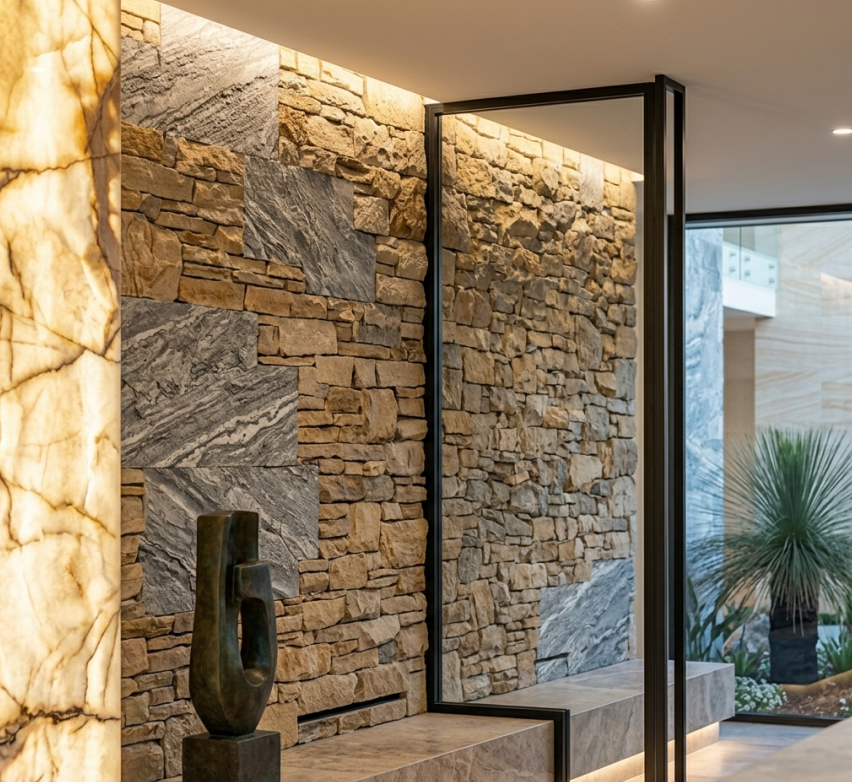
Wall Panels Australia: The Complete Buyer's Guide for 2026

Choosing the right wall panels for your home or commercial project can feel overwhelming when there are so many options out there. Timber slats, stone veneers, PVC boards, carbon crystal panels the list goes on, and they all look different in a showroom than they do on your wall at home.
We put this guide together because our team at Sketch Australia gets asked the same questions every week by homeowners, builders, and architects across the country. What actually lasts? What works in a bathroom? What looks good five years from now and not just in a trend photo from 2023?
Here is what we have found works, what does not, and how to pick the right option for your specific situation.
What Are Wall Panels and Why Are People Choosing Them Over Tiles?
Wall panels are flat or textured sheets that fix to your walls to create a finished surface. They range from thin flexible stone that wraps around columns to rigid carbon composite boards used in high-end commercial fitouts.
The shift away from traditional tiles has been noticeable over the last few years in Australia. There are a few reasons for that. Grout lines get mouldy and are hard to keep clean, especially in bathrooms. Large-format slabs are expensive and heavy. And increasingly, people want a feature wall that looks like a deliberate design choice rather than a tiled surface you see in every new build.
Wall panels solve those problems, but only if you pick the right type for your application.
The Main Types of Wall Panels Available in Australia
1. Thin Natural Stone Veneer Panels
These are our speciality at Sketch Australia and, in our honest opinion, one of the most underused materials in Australian residential design. Thin stone veneer panels are real stone sliced to 1.5 to 2mm thick and bonded to a fibreglass or fabric backing. The result is a sheet that weighs about 1kg, bends around curves, and installs directly onto plasterboard, glass, or render.
They come in slate, marble, sandstone, travertine, and liquid rust finishes. They are suitable for feature walls, bathrooms, facades, fireplaces, and floors. Because they are 100% natural stone, no two sheets look the same.
See our full range: Sketch Australia Thin Stone Veneer Collection
2. Carbon Crystal Boards (CCB)
Carbon crystal boards are a synthetic panel made from a composite material that mimics the look of marble, mirror, timber, and fabric. They are lighter than stone, completely waterproof, and available in very large sheet sizes, which makes them a good choice for shower walls and full-room feature walls where you want minimal joins.
The finish is polished and reflective, which gives them a different look to natural stone. For contemporary commercial fitouts and luxury bathrooms, they are a strong option.
Explore CCB options: Carbon Crystal Board Range
3. Timber and Timber-Look Panels
Timber wall panelling is very popular in Australia right now, particularly slat-style panels and VJ panelling. Natural timber requires sealing and maintenance, especially in wet areas. Timber-look alternatives made from composite or PVC are lower maintenance but do not have the same warmth as the real thing.
If you are going natural timber, make sure it is treated and sealed properly for your climate, particularly in Queensland and coastal areas where humidity causes movement.
4. PVC and Composite Panels
PVC panels are inexpensive, completely waterproof, and very easy to install. They are a practical choice for garage walls, utility spaces, and budget bathroom renovations. The limitation is aesthetics. Even the best PVC panels look like PVC up close, and they can feel hollow underfoot or when tapped.
For a laundry or workshop, they make a lot of sense. For a master bathroom or a living room feature wall, most people find they regret not spending a bit more on something with more material depth.
How to Choose the Right Wall Panels for Your Project

The right panel depends on four things: the room, the substrate, your budget, and how long you want it to last.
• Wet areas (bathrooms, showers): Go with waterproof materials. Natural stone veneer with a penetrating sealer, carbon crystal boards, or quality PVC are all suitable. Unsealed natural stone or MDF-backed panels will not last in a shower.
• Feature walls in living areas: This is where thin stone veneer really shines. The natural texture and variation gives a warmth and depth that synthetic alternatives do not replicate. Slate and marble finishes are the most popular choices.
• Exterior facades and cladding: You need UV resistance and weatherproofing. Thin stone veneer panels with the right sealant work well outdoors. Fibre cement and natural stone cladding panels are also commonly used in Australian construction.
• Commercial fitouts: Carbon crystal boards and large-format stone veneers are well suited to commercial applications because of their large sheet sizes, low maintenance, and consistent appearance across an entire space.
|
A note on Australian Standards Sketch Australia's thin stone veneer panels are compliant with Australian Standards and have been independently fire tested. When specifying materials for commercial projects or multi-residential buildings, always check the test reports and compliance documentation. You can download our test reports here: sketchaustralia.com.au/pages/test-report |
Installation: What Your Trades Person Needs to Know

Most of the wall panels we supply can be installed with a standard construction adhesive, contact cement, or tile adhesive depending on the substrate. Thin stone veneer does not need special skills or tools it cuts with a Stanley knife, scissors, or an angle grinder.
The most common installation mistakes we see involve inadequate substrate preparation and not sealing the stone after installation. Our installation guide covers substrate requirements, adhesive selection, and sealing in detail. It is worth reading before you start, not after.
What Does Wall Panelling Actually Cost in Australia?
Thin stone veneer panels from Sketch Australia start from around $69 per sheet, which covers approximately 0.25 square metres depending on the product. For a 10 square metre feature wall, you are looking at around $2,500 to $3,500 in materials depending on the finish you choose.
Carbon crystal boards are priced at a premium for the sheet size and finish quality. Timber-look and PVC panels are generally cheaper upfront but may need replacement sooner in high-moisture environments.
For large projects or trade pricing, visit our B2B trade page for volume discounts and project support.
Where to Get Help Before You Buy
If you are not sure what will work for your specific project, order a sample pack before committing to a full order. We ship samples across Australia so you can see the real texture and colour in your space before you buy.
Order samples: Sketch Australia Sample Packs
For specification guidance and technical documentation for commercial projects, the Housing Industry Association and the Australian Building Codes Board provide standards references that are useful when specifying cladding materials.