

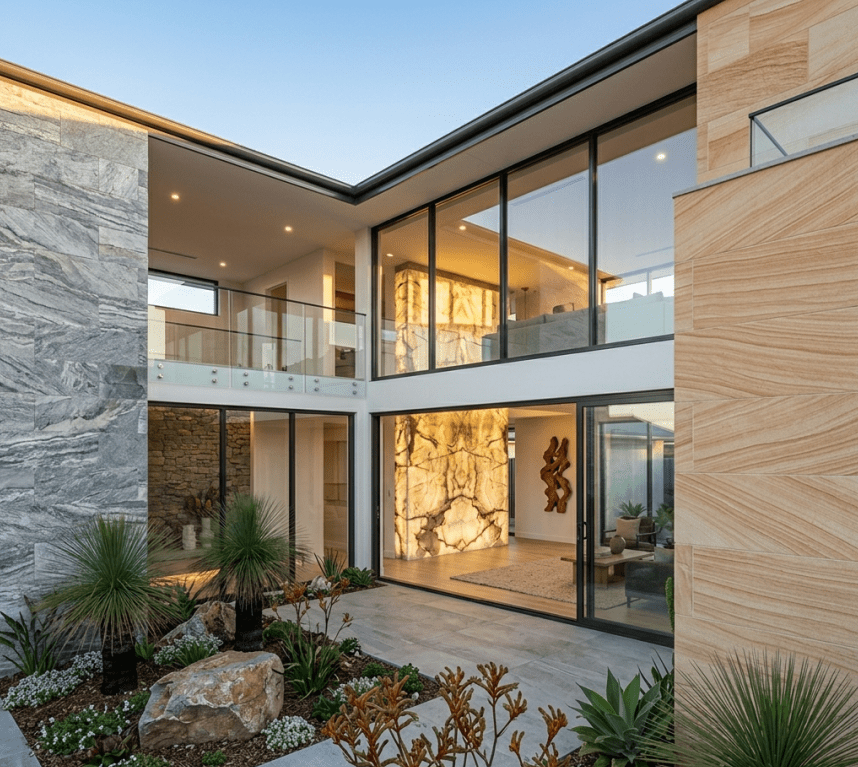

Exterior wall cladding in Australia faces conditions that most imported products were not designed for. Intense UV, wide temperature swings, coastal salt air, bushfire risk in many regions, and humidity in the north all place demands on cladding materials that a product rated for European or American conditions will not necessarily handle.
We have been supplying cladding to Australian builders and architects for over a decade. This guide covers what works, what does not, and what you need to think about before you specify exterior cladding for an Australian project.
The Australian Climate Challenge for Exterior Cladding
Australia has one of the highest UV exposure levels in the world. Materials that perform well in mild climates fade, crack, or degrade much faster here. This is particularly relevant for timber cladding, painted surfaces, and composite materials with organic binder components.
In coastal environments, salt air accelerates corrosion in metallic fixings and degrades adhesive bonds. In tropical Queensland and the Northern Territory, prolonged humidity and cyclonic wind loadings add further requirements. And in the fire-affected regions of Victoria, South Australia, and New South Wales, Bushfire Attack Level (BAL) ratings have become a critical specification consideration following recent fire seasons.
The Australian Building Codes Board sets the relevant standards for exterior cladding materials including fire performance requirements that apply in BAL-rated areas.
Exterior Cladding Options That Work in Australian Conditions
Thin Natural Stone Veneer - Our Recommended Choice
Natural stone is one of the oldest cladding materials on Earth. It does not fade, it does not rot, and it does not corrode. Thin stone veneer panels from Sketch Australia are UV stable, water resistant, and have been independently tested for fire performance.
The practical advantage over traditional stone cladding is weight. Traditional stone facades require structural support and specialised installation. Thin stone veneer at 1 to 2mm thick and approximately 1kg per sheet installs directly onto render, fibre cement sheet, or brick with appropriate adhesive.
Our fire rating documentation and independent test reports are available on our website for architects and builders who need to verify compliance for their specific project.
Browse exterior-rated stone panels: Sketch Australia Exterior Wall Gallery
Fibre Cement Cladding
Fibre cement is the most widely used exterior cladding material in Australian new construction. It is non-combustible, dimensionally stable, and relatively low cost. The limitation is aesthetics. Fibre cement is a background material that gets painted. It does not have the material character of stone or timber.
It is commonly used as the substrate for decorative cladding overlays, including thin stone veneer, rather than as the visible finish layer.
Composite and Timber-Look Panels
Composite cladding panels that mimic timber grain are popular because they offer a timber aesthetic without the maintenance requirements of real timber. Quality varies significantly between manufacturers. In high UV environments, cheaper composites fade noticeably within three to five years.
If you are using composite panels in Australia, check the warranty and UV resistance specification carefully. Products rated for Australian conditions should have UV stability testing in the product documentation.
Natural Timber Cladding
Hardwood timber cladding is beautiful and popular, particularly in Queensland where the architectural tradition includes extensive use of timber. The maintenance requirement is real. Timber needs to be sealed, painted, or oiled on a regular schedule, and it will move with seasonal moisture changes, which can cause cracking and splitting if poorly detailed.
For a bushfire-rated area, the species selection and treatment matters a lot. Some hardwoods carry reasonable BAL ratings but others do not. Always check with your certifier.
What to Check Before You Specify Exterior Cladding
• Bushfire Attack Level (BAL) rating: If your property is in a bushfire-prone area, your cladding must comply with the relevant BAL rating under AS 3959. Check whether the product has been tested and what rating it carries.
• UV stability: Ask for UV resistance data. Look for products tested to Australian conditions, not just international standards.
• Substrate compatibility: What are you fixing to? Render, fibre cement, brick, and timber framing all have different requirements.
• Fixing method: Mechanical fixings corrode in coastal environments. Stainless steel or hot-dipped galvanised fixings are the minimum standard near the coast.
• Expansion allowance: All materials expand and contract with temperature change. Make sure your installation detail accounts for this, particularly over long runs.
|
Compliance Note Sketch Australia's thin stone veneer panels have been independently tested for fire performance. Compliance documentation is available for download from our website. For commercial and multi-residential projects, always engage a building certifier to verify that your specified materials meet the requirements for your specific site and project classification. |
Coastal Installations: What Changes
Salt air does not affect natural stone directly, but it does affect the adhesives and fixings used to install it. In coastal environments, we recommend using marine-grade adhesive systems and stainless steel mechanical fixings where the installation specification calls for them.
We supply to a lot of coastal projects in Queensland, New South Wales, and Western Australia. The stone itself holds up very well. The installation detail is where coastal projects require extra attention.
Getting It Right the First Time
Exterior cladding is difficult and expensive to remedy if it fails. Before you commit to a product, download the technical specifications, check the compliance documents, and if in doubt, contact our team directly through our trade partners page. We work with architects, builders, and project managers on exterior specification projects regularly and are happy to provide guidance.
For trade and volume enquiries, visit our B2B page for project-specific pricing and support.
|
Author Written by the Sketch Australia technical team with reference to Australian Standards and ABCB guidelines. Fire rating and compliance documentation referenced in this article is available on our website. Sketch Australia has supplied exterior cladding to residential and commercial projects across all Australian states and territories. |