

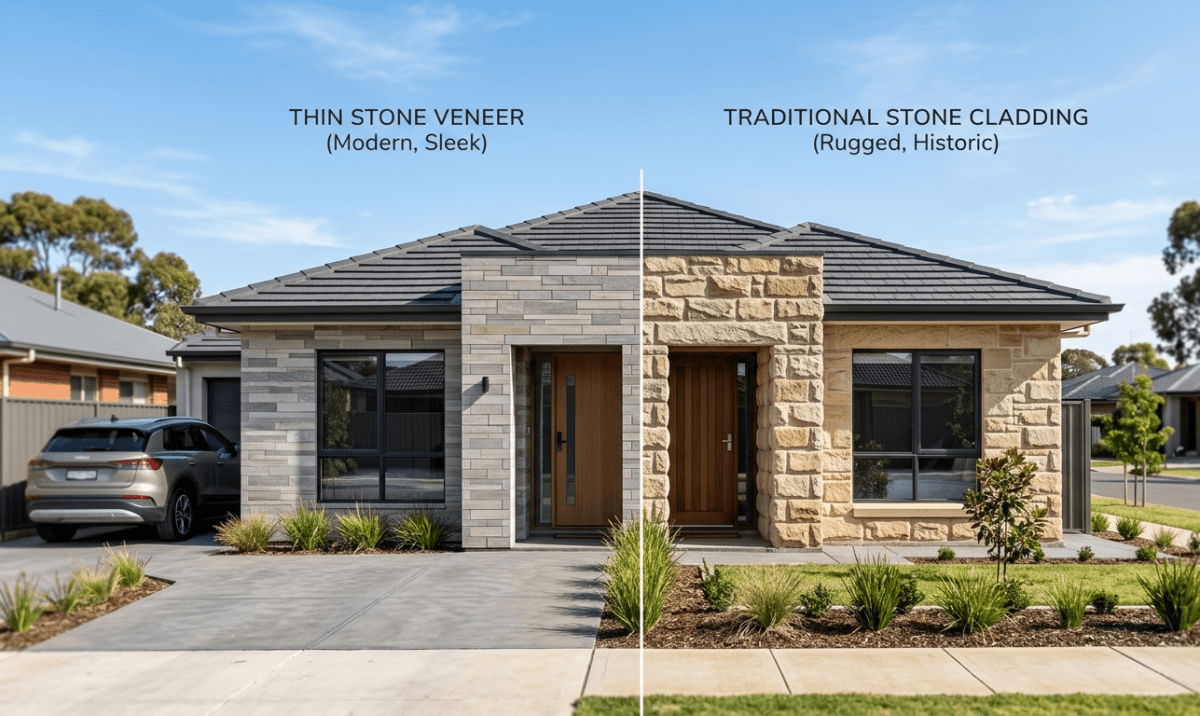

If you want the look of natural stone on your walls, you have two very different ways to get there. Traditional stone cladding has been used in Australian construction for generations. Thin stone veneer is a newer category of product that has changed the equation significantly. Understanding the differences between them helps you choose the right option for your project, your budget, and your wall.
What Is Traditional Stone Cladding?
Traditional stone cladding refers to pieces of natural stone that are cut or split to a thickness of 20mm or more and applied to an existing wall structure. The stone is genuinely thick and heavy. Installation requires a solid masonry or rendered substrate, mechanical fixing in many commercial applications, and a skilled stonemason for larger projects. The weight per square metre is typically between 40 and 80 kilograms depending on the stone species and cut thickness.
Traditional cladding has been used on Australian homes for decades, particularly in period homes, heritage restorations, and high end custom builds where the depth and shadow of thick stone is part of the design brief.
What Is Thin Stone Veneer?
Thin stone veneer panels are made by slicing natural stone to a thickness of 1 to 3 millimetres. This process uses precision cutting equipment rather than any synthetic or manufacturing process. The result is 100 percent genuine natural stone, with all the same colour variation, texture, and character as traditional stone, but at a fraction of the weight.
The thin stone slice is bonded to a fibreglass mesh or flexible polymer backing that holds it together and makes it safe to handle, cut, and install. Sketch supplies thin stone veneer panels in slate, marble, sandstone, quartzite, and several specialty finishes including translucent stone.
Weight Comparison
Weight is the most significant practical difference between the two product types and it has enormous implications for what you can do with each.
Traditional stone cladding at 20mm thickness weighs 40 to 80 kilograms per square metre. Standard residential wall structures are rarely designed to handle this load without engineering assessment, which adds cost and time to any project.
Thin stone veneer panels typically weigh 3 to 8 kilograms per square metre. This is light enough to go directly onto standard plasterboard walls with no structural assessment required. It is also light enough for ceiling applications, furniture installation, and curved surfaces that would be impossible with traditional cladding.
Installation Comparison
Traditional stone cladding
Requires a masonry or rendered substrate. Mechanical fixings are often needed for exterior or large scale applications. Professional installation is typically essential for anything beyond a small garden wall. Installation is slow, labour intensive, and costly.
Thin stone veneer
Installs directly onto plasterboard, concrete, masonry, or timber frame with flexible tile adhesive. No mechanical fixings required for most residential applications. Suitable for experienced DIY installation. Much faster than traditional cladding.
Rule of thumb: A two person professional crew can install approximately 25 to 30 square metres of thin stone veneer per day. The same crew would manage 8 to 12 square metres of traditional stone cladding in the same time.
Cost Comparison
Material costs for thin stone veneer and traditional stone cladding can be similar per square metre for equivalent stone species. The significant cost difference comes from installation. Traditional stone cladding requires specialist labour and often structural engineering assessment. Thin stone veneer can be installed by a tiler or an experienced DIYer.
For a typical 10 square metre feature wall in an Australian home, the total installed cost difference between the two approaches can be $2,000 to $5,000 in favour of thin stone veneer when you account for labour and substrate preparation.
Aesthetics: Does Thin Stone Veneer Look as Good?
This is the question most people ask and the honest answer is that the visual result is virtually identical in most applications. Because thin stone veneer is genuine natural stone with the same face texture, colour, and character as traditional cladding, the finished appearance is extremely similar. The depth of shadow in the joints can vary slightly depending on joint width, but a well installed thin stone veneer wall is indistinguishable from traditional cladding to most observers.
The one area where traditional stone cladding has a genuine aesthetic advantage is in applications where the stone reveals significant thickness at an edge, such as a freestanding garden wall or a window sill where the stone section is visible. In these cases the depth of traditional stone is part of the design. For wall applications where only the face is visible, thin stone veneer delivers the same result.
Durability and Longevity
Both product types use genuine natural stone, which is one of the most durable materials available. The durability of either product in a wall application depends primarily on the installation quality and the choice of adhesive and grout system rather than the stone itself. Properly installed thin stone veneer panels with quality adhesive, grout, and sealer will last as long as a traditional stone cladding installation.
Which Should You Choose?
Choose traditional stone cladding if you need genuine stone depth visible at edges, if you are working on a heritage restoration where the original stone thickness matters, or if you are building a freestanding wall where the stone is structural or semi structural.
Choose thin stone veneer if you are applying stone to a standard residential wall, if budget or timeline matters, if you want to DIY the project, or if your wall structure cannot take the weight of traditional cladding. For the vast majority of Australian residential and commercial interior applications, thin stone veneer is the smarter choice.